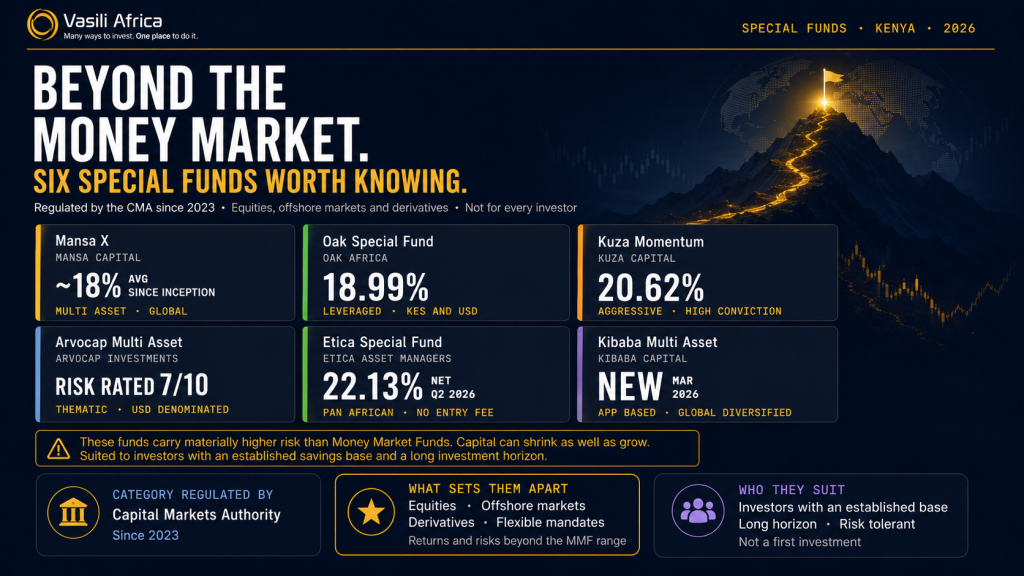
A new type of Kenyan investor is moving beyond traditional options like Money Market Funds, Treasury Bills, and Bonds, searching for greater growth from their capital. In response, Special Funds have emerged in Kenya’s capital markets, regulated by the Capital Markets Authority since 2023. These funds offer flexible mandates, allowing investment in equities, offshore markets, and derivatives—opportunities not available in standard Money Market Funds. While not suitable for everyone, they appeal to investors with established savings who are seeking more active growth options.
Six of them are worth knowing by name;
Mansa-X
Mansa-X is, in many ways, the fund that made this whole category believable. Since its launch in 2019 by Standard Investment Bank, it has quietly become the largest special fund in the country and it did this by doing something almost audacious for its time: letting an ordinary Kenyan investor, in shillings, buy exposure to the same global markets that used to belong only to institutions. A long/short, multi-asset strategy that hedges and trades across geographies, with an average annual return near 18% since inception.
What makes Mansa-X worth writing home about is its range of funds and how widely diversified it is. There is a KES fund (with a current AUM of Kes. 163.84B) a USD fund, (with a current AUM of USD 158.70M) and for those for whom faith shapes finance, a Shariah-compliant version of each with a current AUM of Kes. 3.63B and USD 4.63M, respectively).
Oak Special Fund
Oak special fund is a leveraged asset allocation fund from Faida Investment Bank with an inception of 2024, and it posted the highest return of any special fund in the country: 29.38%. It has since settled into a more modest, still-strong 18.99%, which tells you something true about funds like this- the ceiling is high, but so is the swing beneath it.
Oak comes in both KES and USD with an AUM of Kes19.2B and USD 3.1M, respectfully. There is no separate performance fee here either, just one clean 6% management charge.
Oak is for the investor who wants to be close to the edge of what this category can do who has already built their base elsewhere, and is bringing committed, patient capital here specifically because they want the higher peaks and can hold their nerve through the valleys.
Kuza Momentum Special Fund
There is no gentle way to describe Kuza Momentum: it is the most aggressive fund of the six, and it does not pretend otherwise. In 2024 it delivered a staggering 45.86%, a number that made the rest of the industry pay attention, before normalizing to 20.62% in 2025. That swing, from extraordinary to merely excellent, is the whole story of this fund in a single sentence.
Kuza Momentum rotates freely across equities, fixed income, offshore securities, IPOs and derivatives, chasing whatever the market cycle is rewarding at that moment. It is built for the “aggressive and risk-tolerant” investor. The entry point is low KES 100,000 which means the door is wide open, even if the ride inside is not for the faint of heart. Worth noting for the currency-conscious: this one is KES only. No dollar option, at least not yet.
This is a fund for someone with a genuinely long runway three to five years and who is cushioned enough to take the market waves.
Arvocap Multi-Asset Special Fund
Arvocap’s special fund does something the others don’t quite attempt it invests along themes. Artificial intelligence. Electric mobility. Healthcare innovation. Rather than fixing a static blend of assets, the fund allocates capital toward whatever global macro-theme is gathering momentum, moving across equities, commodities, ETFs, CFDs and structured products in pursuit of it.
It is a USD-denominated fund, with a relatively low dollar entry point of around USD 1,000 and it can be funded via M-Pesa, which lowers the practical friction of getting started. But make no mistake about its risk profile: Arvocap itself rates this fund category 7 out of 10, citing low correlation between assets, leverage, currency volatility, and liquidity risk in stressed markets.
This is a fund for the investor with a five-year-plus horizon who is drawn to the idea of investing who wants their money positioned at the intersection of where the world is heading, not just where it has already been.
Etica Special Multi-Asset Fund
Launched in the last quarter of 2025, Etica Special Multi Asset Fund takes a different geographic bet than its peers, spreading capital not just into global markets, but across Sub-Saharan Africa: NSE and regional equities, EAC government bonds, commercial paper, offshore securities, and even FX trading and securities lending. It posted a strong 22.13% effective net annual yield in Q2 2026, with no initial or exit fee to erode returns at either end.
It is built for the investor who has already arrived, and who wants regional African diversification rather than another purely global or purely domestic bet.
Kibaba Multi Asset Special Fund
Kibaba is the newest of the six, launched in March 2026 by Ndovu Wealth, and it wears its youth as a feature rather than a flaw. Built entirely around an app-based experience, it invests across equities, fixed income, REITs, ETFs and commodities, with allocation adjusted actively using data and economic trend analysis — and unlike its bank-issued peers, it accepts M-Pesa deposits directly, no bank transfer required.
Kibaba offers both KES (minimum KES 250,000) and USD (minimum USD 2,500) options. It is a moderate-risk fund for the investor who already lives digitally and who wants global diversification without walking into a bank branch, and who is comfortable being early to a fund that hasn’t yet built the multi-year track record.
So which fund is good for you?
Looking at these funds side by side, they are not really six versions of the same thing. They are six different answers to the same question: how much of the unknown are you willing to hold, and for how long?
Before you invest a shilling in a Special Fund, sit with this one truth: you are choosing to stop asking your money to be safe, and starting to ask it to work. Those are not the same request, and they don’t deserve the same peace of mind.
Here is what that choice holds.
- Your capital can shrink, not just grow. A Special Fund is a bet, an educated one, often a good one, but a bet nonetheless. Some of these funds have swung from a 45% year to a 20% year in the space of twelve months. That is not the fund failing you. That is the fund being exactly what it always said it was.
- This money needs to be able to disappear for a while. Most Special Funds hold your capital for a minimum of six months before you can touch it, and some are built for three to five years. If there’s a version of you, six months from now, who might need this money for something urgent school fees, a medical bill, a life that doesn’t wait this isn’t where that money belongs.
- Some of these funds borrow to grow. Leverage and derivatives are how the highest returns get made in this category, and they are also how the sharpest losses happen. The same mechanism cuts both ways, always. Ask which of your funds are doing this, and how much.
- The fees are not always what they first appear to be. Some funds take a flat cut. Others take a cut of your growth, on top of a base fee. Ask for the number in writing, not the number in the pitch.
- Choosing dollars over shillings is not the same as choosing safety. It’s choosing a different uncertainty. When the shilling weakens, your dollar fund quietly rewards you. When it strengthens, it quietly costs you. Neither is a shelter – both are weather.
- A young fund is an unread book. Some of these strategies have lived through five years of Kenyan and global market cycles. Others were born a few months ago, in a market that hasn’t yet tested them. That difference matters more than the return sitting on last quarter’s fact sheet.
- And even after the lock-in ends, your money doesn’t return to you instantly. A few business days, typically. This is not where you keep the cash that needs to reach you tomorrow.
The tables below show the returns of the funds as of June 2026. The data is gathered from the fund fact sheets and websites.
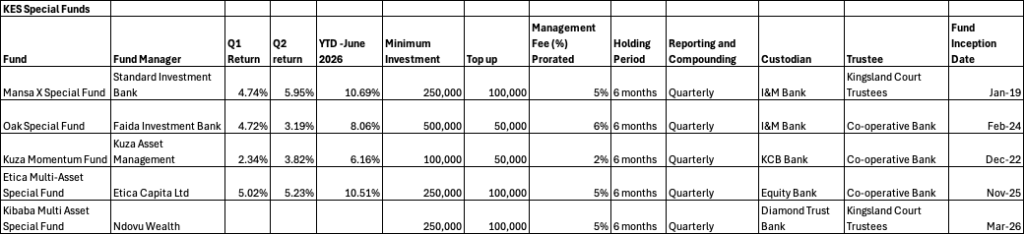



Historical performance is not necessarily indicative of future results.